

Research
The Partnership uses research, data analysis, and market insights to inform and adjust its strategies to spur growth and opportunity across Southeastern Pennsylvania.

The formation of the Greater Philadelphia Growth Partnership and its regional growth strategy draws heavily upon an in-depth evaluation of the region’s economy – its strengths, challenges, and opportunities – released by the Brookings Institution in 2025. Brookings' Southeastern Pennsylvania Market Assessment for Growing Opportunity Industries and Economic Mobility had several key findings that helped shape the Partnership’s work:

-
Southeastern Pennsylvania is underperforming on key measures of economic competitiveness, generating 104,000 fewer jobs in traded-sector industries – those that sell goods and services outside of the region and play an outsized role in driving economic productivity – over the past decade than expected compared to peer benchmarks and ranking last among major U.S. metros in economic mobility for low-income residents.
-
Slow job growth has led to a persistent shortage of quality jobs that offer family-sustaining wages and career pathways for residents in our region. This shortage limits pathways to financial stability and upward mobility.
-
These poor outcomes have persisted in part due to long-standing structural deficits that have held the region back, including no shared regional growth strategy, overreliance on public sector-led program delivery, limited state alignment, and limited business community engagement as a catalyst.
-
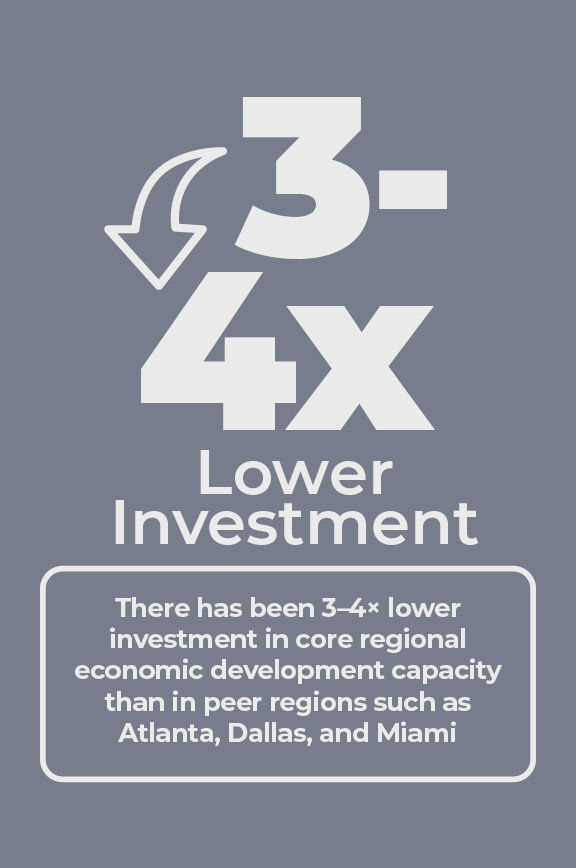
Peer regions have generated better outcomes by taking critical steps that Southeastern Pennsylvania hasn’t – investing three to four times more in core regional economic development activities that help drive growth, focusing energies on strategic cluster-building, and establishing durable collaborative infrastructure to compete nationally and globally.
Where the Region Is Falling Short


Key Findings
The Market Assessment found that Southeastern Pennsylvania faces a dual challenge: lagging growth in traded‑sector industries and worsening economic mobility for low‑income residents. Over the past decade, the region has fallen well short of national benchmarks in generating high‑quality, family‑sustaining jobs, contributing to its last‑place ranking among large U.S. metros for upward mobility.
The analysis shows these outcomes are closely connected. Stronger economic mobility depends on stronger economic growth, particularly in traded industries that drive productivity, higher wages, and new wealth creation. Importantly, the region’s underperformance reflects not a lack of assets, but long‑standing structural barriers in how growth has been coordinated and supported. The findings point toward concentrating collective action where it can have the greatest impact — building on regional strengths, improving competitiveness, and investing in growth capacity that expands access to opportunity and benefits the broader economy over time.
Identified Opportunity Industries:
-
Enterprise Digital Solutions
-
Precision Manufacturing in Industrial Technologies
-
Biomedical Engineering and Production


REGIONAL ECONOMIC DASHBOARD
The Partnership has built up its research capabilities to better support local economic and workforce partners. It also created a Regional Economic Dashboard with regularly updated, customizable data on jobs, industries, and local economic conditions across the region and its counties, helping inform planning and investment decisions. Click here for a quick guide on how to navigate the dashboard.